Paid Ads vs Organic Search: Which Is Right for Your Business?
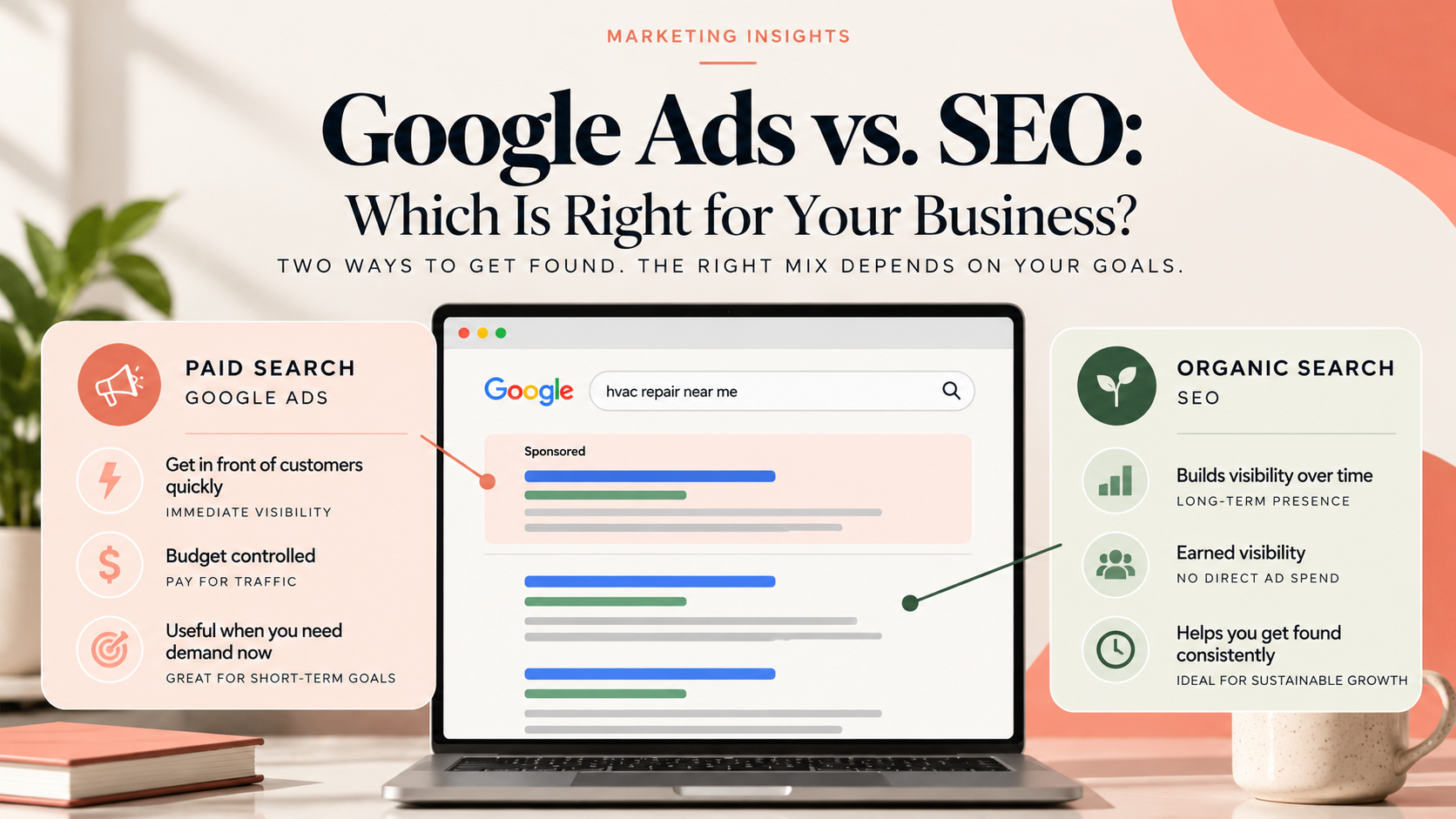
If you're deciding between Google Ads and SEO, the first question isn't which one is better. It's what your business needs marketing to do right now.
Maybe you need more qualified inquiries quickly. Maybe you're getting business from paid ads but want to become less dependent on them over time. Or maybe you're already generating traffic and the bigger problem is what happens after someone clicks.
Google Ads and SEO can both support growth, but they solve different problems on different timelines. The right priority depends on your goals, budget, existing visibility, capacity to handle new opportunities, and what happens after a potential customer finds you.
Understanding the Landscape of Search
When someone searches for a business online, there isn't just one way to show up. Your business might appear through a paid ad, a Local Services Ad, an organic search result, or more than one of those at the same time.
Understanding the difference matters because each one gets you in front of potential customers differently. Here's what that can look like:**.
- Paid Search (Google Ads): These are sponsored listings businesses pay to appear in. Advertisers can control elements such as targeting, messaging, budget and campaign timing.
- Local Services Ads (LSA): A specific type of ad for service-based businesses (like plumbers or electricians) that appears at the very top, often featuring a "Google Screened" or "Google Guaranteed" badge1.
- Organic Results (SEO): These are the "natural" listings. You cannot pay Google to be here; you earn these spots by providing the most relevant, high-quality information for a user’s search.
The Case for Google Ads: Immediate Visibility
Google Ads is often the fastest way to get in front of a potential customer. If you have a new website or a new service, organic search results could take months to gain traction. Paid ads allow you to bypass that wait.
One of the biggest advantages here is control. You can choose the keywords you want to target, the geographic areas you want to reach, when campaigns run and how much you're willing to spend. This is particularly useful for managing your online advertising ROI, as you can turn the volume up or down based on your team's capacity to handle new leads.
For many local companies, local service ads are a strong alternative to traditional PPC. Unlike standard Google Ads where you pay per click, LSAs operate on a pay-per-lead model1. This means you only pay when a customer actually calls or messages you through the ad2. For a small business owner, this often feels like a safer bet because the cost is directly tied to a tangible inquiry.
The Case for Organic Search (SEO): Long-Term Authority
SEO takes a different approach. Rather than paying for placement, you're improving your site's ability to appear for relevant searches over time. That can include your website structure, service pages, local search presence, useful content and other signals that help search engines understand when your business is relevant to a search.
SEO is also about more than keywords. Your website has to help both search engines and potential customers understand what you offer, where you operate and why your business may be relevant to their search. Strong organic visibility can continue bringing people to your business without paying for each individual visit.
Which One Should You Choose?
The "right" choice depends on a few practical factors:
- Your Timeline: If you need leads this week to meet payroll or fill a gap in the schedule, paid ads are the logical starting point. If you are looking at where you want the business to be in twelve months, SEO should be part of the plan.
- Your Budget: Paid search requires ongoing media spend in addition to the work required to manage and optimize campaigns. SEO also requires investment, but the cost structure and timeline are different. The useful question isn't what the average small business spends. It's what your business can invest long enough to generate meaningful data and results.
- How Your Customers Buy: Someone dealing with an urgent AC failure may search and contact businesses very differently from someone planning a kitchen remodel over the next six months. Consider how quickly your customer needs a solution, how much research they typically do and what information they need before contacting a business.
The Middle Ground: A Hybrid Approach
You do not necessarily have to choose one or the other. In fact, Google notes that combining both platforms can help maximize visibility and lead generation3.
You might use Google Ads to capture high-intent traffic for your most profitable services while simultaneously working on SEO for your long-term brand presence. This can give you a way to pursue near-term demand while building your organic visibility over time.
The Channel Isn't the Whole Customer Journey
Whether someone finds you through an ad or an organic result, the click is only the beginning.
What happens next?
Can they quickly understand what you offer and what they should do? Is the phone answered? Does a form submission get a timely response? If they request an estimate or consultation but aren't ready to decide immediately, is there a follow-up process?
That's why I wouldn't evaluate Google Ads or SEO only by traffic. You also need visibility into what happens after that traffic reaches your business.
Before increasing your investment in either channel, make sure the opportunities you're already generating aren't being lost somewhere between the search and the sale.
So, Which Should You Prioritize?
Start with the problem you're trying to solve.
If qualified customers are actively searching for what you offer and you need visibility relatively quickly, Google Ads may deserve more of your attention. If you're building longer-term search visibility and want your business to appear for relevant searches without paying for every visit, SEO may deserve more investment.
In many cases, the answer will eventually include both. But that doesn't mean both need equal investment today.
Look at where your customer journey is currently weakest: being found, generating the right inquiries, converting those inquiries, following up, or understanding what's actually producing customers.
That gives you a much better starting point than asking whether Google Ads or SEO is universally “better.”
If you're not sure where the real gap is, that's exactly the kind of question we can work through together. Click below to schedule a discovery call and discuss your options.
Sources & Further Reading
- 1.Reach Local Customers with Local Service Ads, business.google.com, 2024-12-25
- 2.Google Verified Ads, support.google.com, 2026-10-06
- 3.Google Ads vs Local Services Ads for small business ..., business.google.com, 2025-08-15
Frequently asked questions
Which is cheaper: Google Ads or SEO?
SEO is often considered 'free' because you don't pay for clicks, but it requires a significant investment of time or professional services to see results. Google Ads has a direct cost per click or lead, making it more expensive upfront but faster to implement.
How long does it take for SEO to start working?
While it varies by industry and competition, most businesses start seeing meaningful changes in organic rankings within 3 to 6 months of consistent effort.
Do I have to be 'Google Guaranteed' to run ads?
No, you can run standard Google Ads without it. However, to run Local Services Ads (which appear at the very top of the page), you must go through Google's verification process to earn the Google Guaranteed or Google Screened badge.
Follow Novana
Get the next playbook delivered to your inbox, or follow us for daily insights.